For global buyers, choosing China Pole Bollards involves more than comparing unit prices. These products shape traffic control, pedestrian safety, and site appearance. A suitable bollard must match its environment, impact requirements, installation method, and maintenance plan.
This guide examines how experienced buyers evaluate Pole Bollards from Chinese manufacturers. It considers stainless steel, carbon steel, galvanized finishes, reflective bands, anchoring systems, and custom dimensions. A coastal project may need stronger corrosion resistance, while a warehouse entrance may require clear visibility and dependable impact performance. Product drawings, material certificates, load data, and factory inspection records can reveal more than polished catalog images.
Details matter.
Reliable sourcing also depends on communication and verification. Buyers should request samples, confirm production tolerances, review packaging methods, and clarify replacement support before placing large orders. Factory experience can be valuable, but it should not replace evidence. Some suppliers present broad certifications that do not directly apply to the selected model. That point deserves careful checking.
No manufacturer is perfect. Even a well-designed bollard may face scratches, installation errors, or unexpected site conditions. A thoughtful decision therefore balances price, service, testing, and long-term performance. This article offers a practical framework for comparing China Pole Bollards with greater confidence, while recognizing that local engineering requirements and project conditions still require professional review.
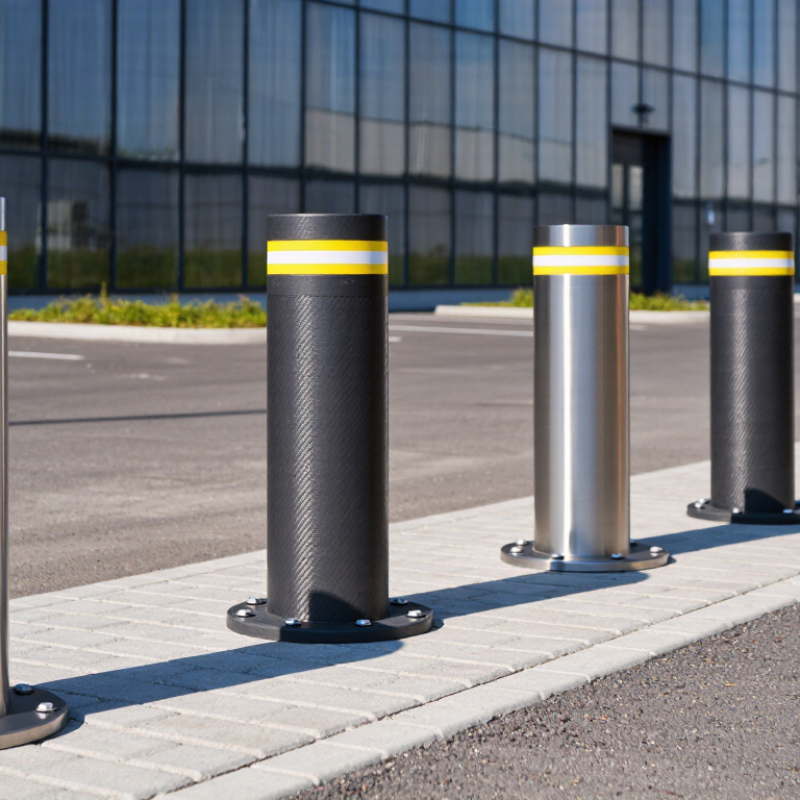
For global buyers, a China pole bollard is defined by its steel specification, not its country of origin. Common fabricated options use Q235B or Q355B structural steel. Q235B offers practical strength for light pedestrian protection, while Q355B provides higher yield strength for heavier impact demands. These grades should not be treated as automatic equivalents to ASTM grades. Request mill certificates, chemical composition, yield strength, tensile strength, and elongation for every production batch.
Diameter and wall thickness control stiffness, weight, and installation cost. Typical steel tube bollards may use diameters from 76 to 219 millimeters, with walls around 3 to 10 millimeters. Those ranges are not design rules. A 114-millimeter tube with a 6-millimeter wall can behave very differently after anchoring, welding, and concrete installation. That assumption is risky. Check the exposed height, vehicle mass, impact speed, base plate, anchor arrangement, and foundation depth. The International Building Code and AASHTO guidance can support structural review, but local project requirements still govern.
China’s manufacturing scale can support consistent sourcing. The World Steel Association’s World Steel in Figures 2025 reports that China produced about 1.005 billion tonnes of crude steel in 2024. Large capacity does not guarantee quality. Buyers should inspect weld penetration, galvanizing thickness, dimensional tolerance, drainage holes, and coating adhesion. Ask for impact testing when security performance matters. Keep it measurable. A simple drawing with tolerances often prevents expensive misunderstandings.

For global buyers, China pole bollards should be compared by tested performance, not appearance or steel thickness. The older U.S. Department of State standard SD-STD-02.01 defines K4, K8, and K12 around a 15,000-pound vehicle. K4 tests impact at 30 mph, K8 at 40 mph, and K12 at 50 mph. The speed difference is substantial. Impact energy rises with the square of speed.
Do not treat K12 as a universal label. ASTM F2656/F2656M-23 uses vehicle class, impact speed, and penetration distance. Its newer M ratings can describe results more precisely than the older K terminology. IWA 14-1:2013 also evaluates hostile vehicle mitigation products, but test setup and reporting details still matter.
Ask for the full test report, vehicle weight, speed, foundation design, and measured penetration. A certificate without these details is weak evidence.
Site conditions can change the result. A K-rated bollard installed in shallow concrete may not perform like the tested assembly. Check soil, drainage, reinforcement, spacing, and emergency access. Hydraulic systems also need cycle testing and manual override checks.
My practical concern is simple: buyers often compare the pole, but the foundation fails first. This comparison is not perfect. Standards evolve, and suppliers may describe equivalent ratings differently. Independent laboratory evidence and installation drawings deserve more weight than a sales sheet.
For global buyers, the key question is not where a bollard is made. It is whether the tested system matches ASTM F2656 or IWA 14-1. ASTM F2656 classifies vehicle impact performance using vehicle type, speed, penetration, and test configuration. IWA 14-1 also evaluates hostile vehicle mitigation, but its ratings and reporting structure differ. These standards should not be treated as interchangeable.
Chinese manufacturers can produce fixed, removable, and automatic pole bollards for these testing systems. However, a domestic Chinese standard is not automatically an ASTM or IWA equivalent. GB/T 31498 addresses protective devices for road vehicles, rather than serving as a direct bollard crash-test replacement. Chinese construction and security codes may guide installation, foundations, and site safety. They do not replace an independent impact report.
Check the complete test evidence. Ask for the tested bollard diameter, steel grade, foundation depth, vehicle mass, impact speed, penetration distance, and spacing. The certificate should identify the exact model, not only a similar product family.
A 275-millimeter bollard tested at M50 cannot prove M30 performance for another design without technical justification.
Site conditions matter greatly. Weak concrete, hidden utilities, or poor drainage can reduce real protection. I would also inspect maintenance records and hydraulic controls, because laboratory strength does not guarantee dependable daily operation.
Some supplier documents look convincing, yet their test scope remains incomplete. That deserves careful questioning.
What Are the Best China Pole Bollards for Global Buyers?
For outdoor pole bollards, galvanizing thickness above 70 μm can significantly improve corrosion resistance. Zinc acts as a sacrificial barrier when moisture reaches the steel surface. In ordinary urban conditions, a thicker coating often supports a longer maintenance interval. Salt spray, standing water, and industrial pollutants can still consume zinc faster. Thickness alone is not enough.
In purchasing inspections, I would check coating thickness with a calibrated magnetic gauge. Measurements should cover the body, edges, weld zones, and recessed areas. A written inspection record improves traceability. Drainage holes also matter. Poor drainage can trap water inside a bollard and create hidden corrosion. That detail is easy to miss.
I once assumed a coating above 70 μm guaranteed decades of service. That assumption was too simple. Steel preparation, bath control, handling damage, and local climate all influence performance. Sharp corners may receive uneven coverage. Threaded areas may need careful protection and inspection. For coastal projects, buyers should request salt-exposure data and repair procedures for damaged zinc. The right specification should connect thickness with site conditions, expected service years, and field maintenance. A heavier coating may raise cost, but replacing corroded bollards later can disrupt paving, traffic flow, and public access.
| Evaluation Dimension | Recommended Specification for Outdoor Pole Bollards | Relevant Technical Data | Effect of Galvanizing Thickness Above 70 µm | Global Buyer Considerations |
|---|---|---|---|---|
| Steel wall thickness | Approximately 3.0–6.0 mm for general pedestrian, perimeter and traffic-control applications; heavier sections may be selected for impact-resistant designs. | Under ISO 1461, fabricated steel with a material thickness of 3.0–6.0 mm has a minimum average zinc coating thickness of 70 µm and a minimum local thickness of 55 µm. | A coating above 70 µm provides additional zinc reserve, provided the coating is continuous and properly bonded. | Confirm the required wall thickness from wind load, impact energy, anchorage and local structural requirements rather than coating thickness alone. |
| Hot-dip galvanized coating level | 70–85 µm is a practical range for many outdoor steel bollard components; 85 µm is commonly associated with steel sections thicker than 6 mm under ISO 1461. | ISO 1461 specifies a minimum average coating thickness of 85 µm and a minimum local thickness of 70 µm for fabricated steel thicker than 6.0 mm. | Moving from 70 to 85 µm increases the zinc mass by about 21% when surface area and zinc density are unchanged. Moving from 70 to 100 µm increases it by about 43%. | Request coating-thickness records based on magnetic measurement, including both average and local readings. |
| Indicative zinc service reserve | Use the coating thickness together with the expected atmospheric corrosion rate at the installation site. | Indicative zinc-reserve calculation: service reserve in years = coating thickness (µm) ÷ assumed zinc loss rate (µm/year). | At a constant loss rate of 2 µm/year, 70 µm provides about 35 years, 85 µm about 42.5 years, and 100 µm about 50 years before theoretical zinc depletion. | These figures are engineering estimates, not guaranteed product lifetimes. Actual performance depends on humidity, chlorides, sulfur compounds, wetting time, sheltering and maintenance. |
| Illustrative atmospheric exposure | Choose the coating margin according to the site environment instead of applying one thickness to every project. | At an assumed zinc loss rate of 1, 2, 4 and 8 µm/year, a 70 µm coating corresponds to approximately 70, 35, 17.5 and 8.75 years of theoretical zinc reserve, respectively. | Increasing the coating from 70 to 100 µm changes the same estimates to approximately 100, 50, 25 and 12.5 years. | Marine splash zones, persistent condensation, industrial pollution and poorly drained details can produce much higher corrosion exposure than a dry rural atmosphere. |
| Surface preparation and coating quality | Clean steel, adequate pickling and fluxing, complete immersion and proper drainage and venting of hollow sections. | Galvanizing thickness may vary by location. Bare spots, runs, ash inclusions and uncoated internal surfaces should be assessed against the agreed standard and acceptance criteria. | A thicker nominal coating cannot compensate for discontinuities, poor adhesion, trapped chemicals or ungalvanized internal surfaces. | Specify inspection, repair limits and sampling method in the purchase documentation. Avoid relying only on a single thickness reading. |
| Design details for hollow pole bollards | Provide suitable vent and drain openings, avoid sealed cavities and design contact areas to prevent water retention. | Proper venting and drainage support zinc access to internal surfaces and reduce the risk of pressure buildup during galvanizing. | Good detailing often has a greater practical effect on durability than a small increase in nominal coating thickness. | Review drawings before production, especially for base plates, closed tubes, overlapping parts, weld areas and threaded connections. |
| Finish and appearance | Accept normal galvanized variation, including differences in brightness, spangle, matte areas and surface texture. | Appearance can vary with steel chemistry, cooling conditions, reactivity and component geometry, while coating thickness remains the primary corrosion-protection measurement. | Higher thickness may sometimes increase surface roughness or visual variation; this does not automatically indicate poor corrosion performance. | Define appearance requirements separately from functional coating requirements, particularly for visible architectural installations. |
| Maintenance and installation | Prevent standing water, avoid damaging the coating during handling and repair small damaged areas with an approved zinc-rich repair system. | Cut edges, drilled holes, weld repairs and severe transport damage require inspection and suitable repair before installation. | Maintenance preserves the effective zinc reserve and can extend practical service life beyond the theoretical depletion calculation. | Specify inspection after installation and establish a schedule based on local exposure, especially in coastal or industrial locations. |
Technical basis: coating-thickness values are aligned with the minimum thickness framework of ISO 1461 for fabricated steel. Service-reserve examples are simplified calculations for comparison only; project specifications should use the applicable national standard, exposure classification, structural design criteria and site-specific corrosion assessment.
For global buyers, a pole bollard should be verified beyond polished photographs. Factory quality begins with traceable control, not a confident sales promise. Ask for a current ISO 9001 certificate, then check its scope, issuing body, and validity. The scope should cover manufacturing or metal fabrication relevant to the bollard. A certificate alone proves process management, not perfect steel or impact performance. This distinction matters.
Request material records for the pole, base plate, anchors, and coating system. Heat numbers, thickness readings, and coating measurements should match the purchase specification. During a factory call, watch how inspectors measure wall thickness and weld dimensions. They should use calibrated tools and retain inspection records. Missing records are a warning, but one missing file does not always prove poor production. I have seen small factories improve quickly after buyers defined acceptance criteria clearly. That experience also taught me to question friendly assurances.
Load tests should use a documented fixture, measured force, and visible deformation readings. Ask for the test date, sample identification, failure point, and signed results. A report without setup photos is weak evidence. Order production samples, not showroom pieces. Check weld continuity, sharp edges, flange flatness, drain holes, coating adhesion, and packaging protection. Install one sample on representative concrete when possible. It may reveal anchor mismatch or water pooling. Verify twice. A reliable supplier accepts reasonable rejection criteria and explains deviations before shipment.
The chart shows the core evidence global buyers should verify before placing an order. ISO 9001 certification confirms that a quality management system has been assessed, while load-test reports and physical samples provide product-specific evidence. Because load capacity and sample requirements vary by design and application, buyers should confirm the test method, acceptance criteria, and sample results directly with the factory.