Leave Your Message

10 Essential Tips for Choosing Warehouse Bollards

A warehouse bollard may look like a simple steel post, but it protects people, racks, doors, columns, and automated equipment from costly impacts. Forklifts move quickly through narrow aisles, often within inches of stored products and building structures. One careless turn can damage a loading door or stop an entire dispatch area.

The 2024 MHI Annual Industry Report highlights continuing pressure on warehouses to improve resilience, productivity, and workforce safety. It also identifies labor challenges and operational disruption as major concerns for supply chain leaders. These pressures make physical protection more important, not less. OSHA’s warehousing guidance repeatedly stresses traffic management, clear pedestrian routes, equipment awareness, and hazard control. The U.S. Bureau of Labor Statistics also continues to report serious injuries connected with transportation, material handling, and workplace contact incidents. The message is practical. Impact prevention deserves planning.

Warehouse Bollards support that planning when selected for the actual site. Their height, steel thickness, anchoring method, visibility, spacing, and energy rating must match the hazard. A thin post beside a high-speed dock may provide confidence without adequate protection. That is a costly assumption. FM Global property loss prevention guidance also supports combining physical safeguards with organized traffic control and maintenance practices.

This guide examines ten essential selection tips, from impact resistance and installation depth to visibility and long-term maintenance. It also questions common shortcuts. A painted barrier is not automatically a safe barrier. The warehouse itself must decide.
10 Essential Tips for Choosing Warehouse Bollards

Map warehouse impact risks using OSHA 1910.176(a) and forklift data

10 Essential Tips for Choosing Warehouse Bollards

Map warehouse impact risks before selecting protection. OSHA 1910.176(a) requires sufficient safe clearances for aisles, loading docks, doorways, turns, and passageways. It also requires aisles to remain clear and in good repair. The rule does not prescribe one bollard size or spacing. Use forklift data to identify real exposure points. Review impact reports, near misses, travel speeds, load weights, turning patterns, and damaged rack legs. A yellow scrape at a dock corner tells a useful story.

Tip 1: Mark forklift routes on a current floor plan.
Tip 2: Highlight blind corners and narrow doorways.
Tip 3: Measure clearance with the largest regular load.

Tip 4: Separate pedestrians from moving equipment.
Tip 5: Protect rack uprights, controls, and fire equipment.

Steel posts may suit repeated impacts, while flexible barriers may fit lighter traffic. Match protection to likely impact energy, not appearance.

Tip 6: Check floor condition before anchoring posts.
Tip 7: Keep bollards outside required aisle clearance.
Tip 8: Use contrasting colors for visibility.

Tip 9: Inspect anchors after every collision.
Tip 10: Recheck protection after layout changes.

Our first risk map looked complete, but it missed a temporary staging area near a dock. That mistake mattered. Forklift records are imperfect too, especially when minor contact goes unreported. Ask operators what happens during busy shifts. Their observations often reveal risks that drawings overlook.


Set bollard locations around racks under ANSI/RMI MH31.1 clearances

Choosing warehouse bollards starts with the rack layout, not the bollard color. OSHA estimates that powered industrial trucks cause about 85 workplace deaths and 34,900 serious injuries annually. Source: OSHA, Powered Industrial Trucks safety guidance. These figures justify physical protection at exposed rack uprights, end frames, corners, and pedestrian crossing points.

Map every impact path before selecting a barrier. Measure the rack leg position, forklift turning envelope, aisle width, and emergency access. Apply the clearance criteria required by the applicable ANSI/RMI MH31.1 edition and approved rack drawings. Do not copy a generic distance from another facility. Clearances can change with truck type, load length, rack depth, and floor conditions. Leave enough space for deflection after impact. That detail is often missed.

Check ten practical points: visibility, height, energy rating, anchor depth, slab thickness, drainage, sprinkler access, pedestrian separation, inspection access, and replacement planning. Never attach protection to a rack upright without engineering approval. Confirm that anchors avoid reinforcement and utilities. BLS reported 1,495 fatal injuries in transportation and material-moving occupations in 2023, showing why vehicle separation deserves careful planning. Source: U.S. Bureau of Labor Statistics, Census of Fatal Occupational Injuries, 2023. A tidy plan can still fail. Recheck clearances after relocations, new trucks, and damaged floors. Capture measurements, photos, and inspection dates in the site record.

Choose bollard designs by ASTM F3016 impact-energy test ratings

10 Essential Tips for Choosing Warehouse Bollards

Choose bollards by ASTM F3016 impact-energy ratings, not appearance alone. ASTM F3016 evaluates surface-mounted bollards under low-speed vehicle impacts. Its results help compare tested energy resistance, vehicle conditions, and mounting performance. A 10,000 ft-lb rating means little if the warehouse floor, anchors, or spacing differ from the test setup. Read the complete test report. Check impact energy, vehicle mass, speed, impact angle, and damage limits. The rating is evidence, not a guarantee.

Tip: Match the rating to real traffic.

OSHA estimates that powered industrial trucks cause about 85 deaths and 34,900 serious injuries annually in the United States. BLS data also places transportation and material-moving work among the country’s higher-risk occupational groups. These figures support stronger separation around pedestrian doors, rack ends, charging areas, and exposed columns. Use ASTM-rated designs where a loaded forklift could strike repeatedly. Keep clear sightlines and adequate turning space. A stronger bollard can still create a new hazard when poorly positioned.

Tip: Inspect the foundation, not only the steel.

In warehouse projects, I have seen attractive barriers loosen because installers ignored slab thickness and edge distances. That mistake is easy to miss. Confirm the tested anchoring method, concrete condition, and post spacing. Consider replaceable components after impact, but do not assume “repairable” means “safe.” One overlooked detail remains: changing the base plate or anchor pattern may invalidate the tested performance. Review drawings with a qualified safety professional before installation.

Improve visibility with OSHA 1910.144 safety-color requirements

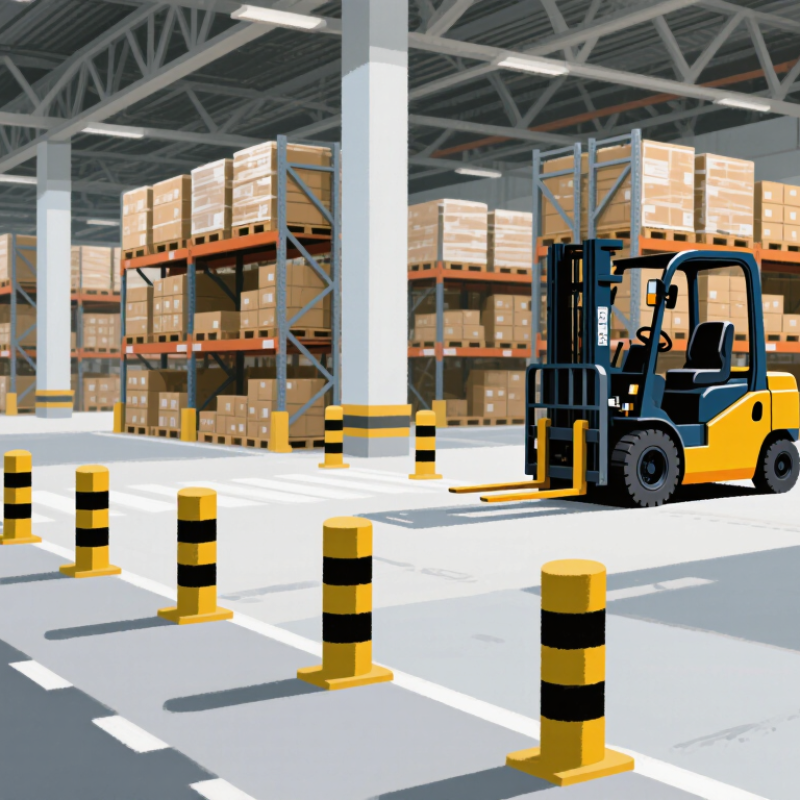
Warehouse bollards do more than protect racks and doors. They help workers recognize hazards before a collision occurs. OSHA 1910.144 identifies yellow as the safety color for physical hazards, including striking, stumbling, falling, and caught-in-between risks. Red is reserved for danger signs and fire-protection equipment. Therefore, yellow bollards are usually the clearer choice near pedestrian routes and vehicle lanes.

Visibility depends on placement, contrast, and maintenance. Choose a finish that remains visible beside gray concrete, dark shelving, and shrink wrap. Add reflective bands where forklifts operate during low-light shifts. The standard does not prescribe one bollard design, so site-specific judgment matters. Keep the bollard outside the turning path, yet close enough to shield the hazard. A bright post in the wrong position still fails.

The Bureau of Labor Statistics reported 865 workplace fatalities from transportation incidents in 2022, making vehicle-pedestrian separation a serious planning issue. The Liberty Mutual Workplace Safety Index estimated more than 1 million serious workplace injuries in 2021, with substantial associated costs. These reports support practical controls, not decorative upgrades. During inspections, check for faded paint, blocked sightlines, loose anchors, and damaged reflective material. Small defects are easy to dismiss. That can be a costly mistake. Record the inspection date and replace unclear markings before workers adapt to them. Consider ANSI safety-sign principles for consistent contrast, but verify the final layout against your facility’s traffic plan and OSHA requirements.

10 Essential Tips for Choosing Warehouse Bollards - Improve Visibility with OSHA 1910.144 Safety-Color Requirements

No. Selection Dimension Practical Requirement or Data Point Recommended Application Verification Checklist
1 Identify the Hazard Assess vehicle impact, pedestrian exposure, falling objects, pinch points, rack movement, and equipment clearance before selecting a bollard. Use impact protection at rack ends, doors, corners, columns, machinery, utility equipment, and pedestrian walkways. Document the vehicle type, travel direction, operating speed, load condition, and likely impact points.
2 Match the Impact Capacity Select a tested or engineered system with a stated energy capacity. Impact energy can be estimated using E = ½mv², where mass is in kilograms and speed is in meters per second. Use higher-capacity protection in forklift aisles, loading areas, and locations exposed to repeated vehicle movement. Confirm that the published rating reflects the complete system, including the post, base plate, anchors, and installation surface.
3 Use OSHA Safety Colors Correctly OSHA 29 CFR 1910.144 identifies yellow for caution and physical hazards, including striking, stumbling, falling, tripping, and caught-in-between hazards. Red identifies danger, fire protection equipment, and stop controls. Use high-visibility yellow or yellow-and-black markings for warehouse bollards that protect against physical hazards. Reserve red for danger or fire-protection identification. Ensure the color is visible from normal approach directions and is not confused with emergency stop or fire-protection signage.
4 Improve Day and Low-Light Visibility Choose durable high-visibility coatings, reflective bands, or reflective sheeting where lighting changes, vehicle headlights, or night operations reduce contrast. Apply enhanced visibility at dock doors, aisle intersections, ramps, freezer entrances, and dimly lit storage areas. Check visibility from forklift height, pedestrian eye level, both travel directions, and the farthest normal stopping distance.
5 Select an Appropriate Height There is no single OSHA bollard height requirement. Common warehouse protection posts are often approximately 900–1,200 mm high, but the final height depends on the hazard and vehicle geometry. Use a height that remains visible above pallets, cartons, carts, and other stored materials without obstructing required sightlines. Review the tallest normal load, operator sightlines, door operation, sprinkler clearance, and local building requirements.
6 Check Diameter and Clearance Typical steel protection posts may use outside diameters around 100–150 mm; the required size depends on impact demand and structural design. Choose a diameter that provides adequate strength while preserving aisle width, door clearance, pallet access, and pedestrian space. Measure the finished installation, including base plates, anchor projections, guardrails, rack uprights, and turning paths.
7 Choose the Correct Mounting Method Permanent core-drilled or base-plated systems generally provide stronger restraint than temporary surface-mounted solutions, provided the substrate and anchors are suitable. Use engineered anchoring for high-impact areas and removable or surface-mounted systems where access, cleaning, or layout changes are important. Verify concrete thickness, edge distance, anchor type, embedment, slab condition, torque requirements, and the installation drawing.
8 Consider Material and Environment Carbon steel provides high structural strength when properly protected. Stainless steel or corrosion-resistant finishes may be more suitable for wet, corrosive, refrigerated, or washdown environments. Match the finish to moisture, cleaning chemicals, salt exposure, temperature, and hygiene requirements. Confirm coating compatibility, corrosion resistance, drainage, weld quality, and temperature performance before installation.
9 Protect Pedestrian and Vehicle Routes Separate pedestrians from powered industrial truck traffic wherever feasible. Bollards should not create new trip hazards, reduce required egress width, or obstruct fire equipment. Place protection at walkway edges, crossing points, doors, columns, and rack corners while maintaining the facility’s required clearances. Review the layout with site safety personnel, forklift operators, facilities staff, and the authority having jurisdiction when required.
10 Plan Inspection and Replacement Inspect posts after every known impact and during scheduled workplace inspections. Look for bending, cracking, loose anchors, damaged coatings, concrete failure, and reduced visibility. Replace or repair damaged components before returning the protected area to normal operation. Maintain an inspection log with location, date, damage condition, corrective action, responsible person, and close-out date.
Compliance note: OSHA 29 CFR 1910.144 establishes safety-color meanings, but it does not prescribe one universal warehouse bollard height, diameter, spacing, or impact rating. Final specifications should be based on the site risk assessment, equipment traffic, substrate, applicable building and fire codes, and the bollard manufacturer’s engineered installation requirements.

Verify anchoring capacity with ACI 318 and manufacturer test data

Warehouse bollards do more than mark safe boundaries. Their anchors transfer impact forces into the concrete floor, so capacity deserves careful verification.

Use ACI 318 provisions to review anchor strength, concrete breakout, pullout, shear, edge distance, and spacing. These checks should reflect cracked concrete when the slab condition is uncertain. Consider vehicle speed, mass, impact angle, and the number of impacts expected. A static load calculation may look reassuring, yet it can miss real collision behavior. It is not enough.

Request manufacturer test data for the exact bollard, anchor type, embedment depth, and concrete strength. Look for documented test methods, failure modes, fixture details, and safety factors. Data from a different base plate or substrate may not apply. Ask whether testing used cracked concrete and whether anchors were installed with specified torque or adhesive curing time.

Inspect the slab before drilling. Locate reinforcing steel, joints, voids, and damaged concrete. Confirm hole diameter, depth, cleaning, and torque during installation. Record these details with photographs and inspection notes. Small deviations matter. A neat design can fail through poor installation.

When conditions differ from the test setup, obtain a qualified structural review. I have seen projects rely too heavily on catalog capacity. That habit needs challenging. The safest selection connects calculations, credible testing, and what exists beneath the warehouse floor.